Have you ever been sitting at home, maybe relaxing on the couch after a long day, when suddenly tomorrow’s presentation, meeting, or important event pops into your mind? In an instant, something shifts. Your stomach drops. Your heart starts racing. A wave of dread moves through you. And almost immediately, your mind begins to fill in the blanks:
What if I mess up?
What if everyone is judging me?
What if I completely forget what I’m going to say?
Before long, the mind has already gone a step further: “If I make a mistake, everyone will think I’m incompetent… and I could lose my job”
If this sounds familiar, you’re not alone. As a therapist, this is something I hear all the time - and something I also understand from a human level. That sudden shift from a neutral moment into worry, fear, and self-doubt is one of the most common ways anxiety shows up. And often, it catches people completely off guard.

What Actually is Anxiety? (beyond the label)
Anxiety is a natural response from your nervous system designed to protect you. It is your body’s internal alarm system - built to detect potential threat and prepare you to respond. This is part of the fight-flight-freeze response, which activates automatically when your brain senses danger. From a clinical perspective, this system is essential for survival. It helps you react quickly in situations that require action. The challenge is that anxiety doesn’t only respond to actual danger. It also responds to perceived threat - situations that feel uncertain, emotionally risky, or overwhelming.
Therapist Perspective - One of the things I often hear in therapy is: “I know I’m safe, but my body doesn’t feel safe.” This is a key part of anxiety. The nervous system can activate even when there is no real danger present. Anxiety is not a sign that something is wrong with you - it is a sign your system is trying to protect you, sometimes a little too strongly.
What Anxiety Feels Like
Anxiety does not look the same for everyone, which is part of what makes it confusing. For some people, it is mostly mental. For others, it is physical. And for many, it is both.
Mentally, anxiety can feel like:
Racing thoughts
Overthinking situations
Replaying conversations
“What if” thinking
Difficulty concentrating
Expecting the worst-case scenario
It can feel like the mind will not switch off, even when you want it to. For example, you might spend a long time replaying a conversation and analysing whether you said the wrong thing, even when there is no clear evidence that anything went wrong.
Emotionally, anxiety can feel like:
Worry
Fear
Dread
Irritability
Feeling on edge
A sense that something is wrong, even if you can’t name it
Sometimes anxiety is loud and intense. Other times, it is a quiet background sense of unease.
Physically, anxiety can feel like:
Tight chest or throat
Racing heart
Shallow breathing
Muscle tension
Stomach discomfort
Restlessness
Fatigue
Many people first notice anxiety in the body before they ever identify it in the mind.
Behaviourally, anxiety can look like:
Avoiding situations
Over-preparing
Procrastinating
Seeking reassurance
Double-checking decisions
Trying to control outcomes
These behaviours are not random - they are attempts to feel safer or reduce uncertainty.
How Anxiety Shows Up in Everyday Life
When people think about anxiety, they often picture panic attacks or obvious worry. But anxiety can show up in much more subtle ways throughout daily life. For example, anxiety might look like:
Re-reading an email five times before sending it
Constantly checking that you didn’t make a mistake
Mentally rehearsing conversations before they happen
Replaying conversations long after they end
Putting off tasks because they feel overwhelming
Struggling to relax even when you have free time
Feeling responsible for making sure everything goes smoothly
Over-preparing for situations “just in case”
Frequently seeking reassurance from others
Staying busy because slowing down feels uncomfortable
Therapist Perspective: Many people tell me, “I didn’t think I had anxiety because I’m still functioning.” Anxiety is not always obvious or intense. Sometimes it looks like perfectionism, people-pleasing, overthinking, or feeling responsible for everything going smoothly. For many people, anxiety does not feel like fear - it feels like pressure. A constant sense of needing to stay on top of things, prevent mistakes, or make sure nothing goes wrong.
Once we recognize how anxiety shows up, the next question becomes: why does it happen in the first place?
Why Anxiety Happens (and What It’s Responding To)
One of the most important shifts in understanding anxiety is recognizing that it is not only triggered by danger, but by perception of threat. The brain is constantly scanning for anything that might feel uncertain, emotionally risky, or overwhelming.
This can include situations such as:
Speaking in a meeting
Sending an important message
Having a difficult conversation
Waiting for a response
Making a mistake in front of others
These situations are not physically dangerous, but they can feel threatening to the nervous system. When this happens, the brain activates the fight-flight-freeze response automatically - preparing you for danger even when you are safe.
What’s Happening in the Nervous System
To understand anxiety more clearly, it can be helpful to zoom out and look at what is happening in the body. Anxiety is not only a thought process - it is a full nervous system response. When your brain senses a possible threat, it automatically activates the fight-flight-freeze system. This is your body’s built-in survival response, designed to help you react quickly and stay safe. In these moments, your body prepares as if something needs immediate attention, even if there is no actual danger present. This is why anxiety can feel so physical. Your heart rate may increase, your breathing may change, your muscles may tense, and your body may feel “on alert.”
Therapist Perspective: One of the things I often explain in therapy is that anxiety is not something you are consciously choosing. It is something your nervous system is doing automatically in response to perceived threat. This is also why anxiety can feel so confusing - because your body can react before your thinking mind has had a chance to catch up.
Why Anxiety Feels So Real (and So Hard to “Logic Away”)
One of the most frustrating parts of anxiety is that it often doesn’t respond to logic in the way we expect it to. You may understand that you are safe. You may recognize that a worry is unlikely to happen. You may even know that your anxious thoughts don’t fully make sense. And yet, your body can still react as if there is a real threat present. This happens because anxiety is not just a thinking process - it is also a nervous system response. When the brain detects a possible threat, the body begins preparing for action before your conscious mind has fully evaluated the situation. As a result, there can be a disconnect between what you logically know and what you physically feel.
Your mind may be saying: “I’m probably okay.”
While your body is saying: “Something feels wrong.”
For example, you might think:
“The presentation will probably be fine”
Yet still feel:
Tense
Restless
On edge
Unable to settle
Or you might think: “My friend is probably just busy.” Yet still feel the urge to check your phone repeatedly or replay the last conversation in your mind.
One of the reasons anxiety feels so convincing is that it creates a sense of urgency. Anxiety rarely presents itself as a possibility. Instead, it often feels like something that needs immediate attention. In those moments, the brain prioritizes safety over accuracy. Its goal is not to determine whether a threat is actually present - it is to make sure you don’t miss one if it is.
Therapist Perspective - One of the most common things I hear from clients is: “I know it doesn’t make sense, but I still feel anxious.” Many people assume this means they are being irrational or doing something wrong. In reality, it is often a sign that the nervous system has become activated. This is where many people get stuck. They try to think their way out of a response that is also happening in the body. Understanding this can be incredibly relieving because it shifts the goal. Rather than trying to argue with anxiety or force it away, we can begin learning how to work with both the mind and the nervous system together.
This is also why lasting change often involves more than simply changing thoughts - it involves helping the body learn that it is safe again.
The Anxiety Cycle
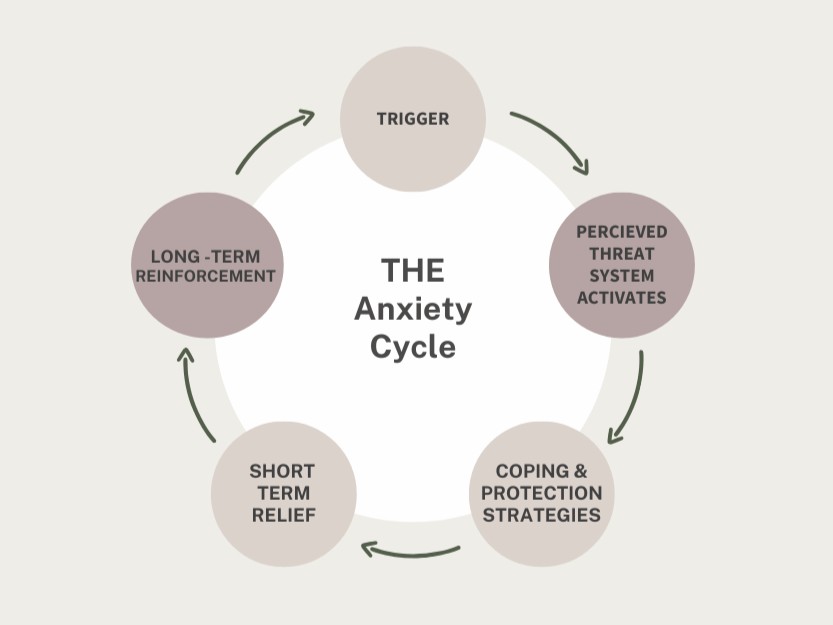
I find that anxiety is best understood as a cycle or a loop rather than a single experience. Once the cycle begins, each part feeds into the next. I typically use the Cognitive Behavioural Therapy Model as a guide here as I think that it breaks down the cycle into digestible steps. I often explore this with clients in sessions, because once people can see the pattern clearly, it becomes much easier to work with.
1. Trigger → Something activates the nervous system. This could be:
an external situation (work, relationships, social interaction)
an internal thought (“What if something goes wrong?”)
a memory or anticipation of something
a physical sensation (tight chest, racing heart)
Important note: triggers are not always obvious. Sometimes the “trigger” is simply a feeling state.
2. Anxiety Response (perceived threat system activates) → The brain interprets the trigger as something that needs attention or protection This can show up in many different ways:
Thoughts:
Something is wrong
I need to fix this
What if this goes badly
Body:
Racing heart
Tight chest
Restlessness
Muscle tension
Emotion:
Fear
Worry
Overwhelm
Urgency
At this stage, many people assume the anxiety is the problem. But in reality, this is just the body trying to protect you.
3. Coping or Protection Strategies (what we do next) → Naturally, the mind tries to reduce discomfort as quickly as possible. This is where coping strategies come in. Common ones include:
Overthinking - Replaying a conversation from three days ago trying to determine whether you said the wrong thing.
Reassurance Seeking - Asking friends or family repeatedly if everything is okay.
Perfectionism - Spending 45 minutes writing an email that could have taken five.
Avoidance - Putting off making a phone call because you're worried about how it will go.
Procrastination - Delaying a task because you're afraid of making a mistake.
Distraction - Scrolling, staying busy, and disconnecting.
All of these strategies share the same goal - “I want to feel safe again.”
Therapist Perspective: This is often the point where clients become frustrated with themselves. They know avoiding something isn't helping, yet they feel pulled to do it anyway. That's because avoidance isn't a character flaw - it's a protective strategy. Your brain is trying to reduce discomfort as quickly as possible.
4. Short-term relief → These strategies usually work, at least temporarily. You might notice a drop in anxiety, a sense of relief, feeling “lighter” or even having temporary clarity. And this is exactly why these patterns end up being so sticky, because they work. The brain learns “That worked. Lets do it again next time”.
5. Long-term reinforcement → Over time, the brain learns to rely on these strategies.
This can lead to:
More sensitivity to anxiety triggers
Less tolerance for uncertainty
Increased reliance on avoidance or control
A stronger anxiety response over time
This is how the cycle strengthens, not because you are doing something wrong, but because the brain is learning from repetition. So the next time a similar trigger appears, the anxiety system activates faster and more strongly. Which, overtime, this can lead to increased sensitivity to stress, stronger anxiety responses, reduced confidence in coping ability and a shrinking comfort zone.
Why Anxiety Persists Over Time
Anxiety tends to persist not because it is random, but because it is reinforced through a combination of:
avoidance of discomfort
short-term relief cycles
increased sensitivity to internal sensations
and reduced exposure to uncertainty
Over time, the nervous system learns: “I am safer when I avoid, control, or prepare excessively.”
While these strategies feel protective, they also keep the cycle active.
Therapist Perspective: Many people assume that if anxiety is still showing up, it means they aren't trying hard enough or that they're somehow failing. From a therapeutic perspective, anxiety often persists because the nervous system has learned a particular pattern - not because a person lacks willpower or motivation.
Different Patterns of Anxiety
Anxiety always follows the same underlying cycle, but it can appear in different ways:
Overthinking anxiety: A mind that continuously analyses, predicts, and replays.
High-functioning anxiety: Appearing capable externally while internally feeling pressure, urgency, or overwhelm.
If this resonates with you, check out our blog on “High-Functioning Anxiety: Calm on the Outside, Overwhelmed on the Inside”
Perfectionism-based anxiety: Fear of mistakes, judgment, or not meeting internal expectations.
Stress-based anxiety: Anxiety that builds gradually under ongoing pressure or burnout.
Each pattern is understandable, and each one follows the same cycle described above.
When Anxiety Becomes a Problem
Anxiety itself is not the problem. Anxiety is a normal and necessary part of being human. Everyone experiences anxiety at different points in life - especially during times of stress, uncertainty, or change. The question is not whether you experience anxiety. The question is whether anxiety is starting to take up more space in your life than you would like.
When anxiety may be becoming more difficult to manage:
Worry feels constant or hard to control
You spend a lot of time overthinking or “figuring things out”
You avoid situations because of anxiety or fear
Anxiety is impacting your work, relationships, or daily functioning
It feels difficult to relax, even when nothing is wrong
You feel mentally or emotionally exhausted from being “on”
Decision-making feels increasingly difficult
You rely heavily on reassurance or control to feel okay
Physical symptoms of anxiety are frequent or distressing
Therapist Perspective: One of the things I often remind clients is that anxiety doesn’t have to feel extreme to become impactful. Sometimes anxiety becomes a problem very gradually. Not through one big moment - but through small patterns over time.
People begin to:
Speak up less
Avoid difficult conversations
Turn down opportunities
Overthink decisions for long periods
Doubt themselves more often
Organize their life around avoiding discomfort
Slowly, life can start to feel smaller - not because the person is incapable, but because anxiety is shaping more of their choices.
A Helpful Reframe
Instead of asking: “Do I have anxiety?”
It can be more helpful to ask: “How much is anxiety influencing the way I live my life?”
That question often gives a clearer picture of whether anxiety is something that may benefit from additional support or attention.
Breaking the Anxiety Cycle -
Practical Steps You Can Start Today!
The anxiety cycle can feel powerful, but here are small, gentle steps you can begin taking on your own. These aren’t about forcing yourself into situations or pushing past your limits - they’re about building awareness, self-compassion, and new habits that can start to shift the pattern over time.
-
One of the most important steps is simply recognizing when you’re entering Stage 1. Slow down and name what you’re feeling:
“My chest feels tight.”
“My thoughts are racing.”
“I feel overwhelmed right now.”
This awareness pulls you out of autopilot mode and gives you a chance to respond more intentionally, instead of reacting impulsively.
-
Avoidance can often feels automatic, but you can begin to interrupt it by naming it:
“I want to avoid this.”
“I’m having the urge to escape.”
You don’t need to act on the urge. You’re just creating awareness towards it. This small pause is incredibly powerful and can create just enough distance between you and the automatic behaviour.
-
When anxiety hits, grounding can help bring you back into the present moment, making the situation feel less overwhelming. A few options:
The 4-7-8 breath:
Inhale for 4 seconds, hold for 7, and exhale slowly for 8.The 5-4-3-2-1 sensory practice:
Notice 5 things you see, 4 you can touch, 3 you hear, 2 you smell, 1 you taste.Temperature change:
Holding something cold or splashing your face with water can help interrupt the physiological stress response.These techniques don’t “fix” anxiety - but they reduce its intensity enough to help you take the next step.
-
Instead of avoiding the entire situation, try taking just one manageable step forward. For example:
If you’re anxious about a task, focus on starting for five minutes.
If social anxiety appears, try sending one text or attending for a short amount of time.
If driving makes you anxious, practice sitting in the car before pulling out of the driveway.
Small actions send your brain the message that you can handle the situation, even if it feels uncomfortable.
-
Anxiety tends to peak, plateau, and eventually fall - whether we avoid the situation or not. If you stay present, you may notice that the intensity changes. Remind yourself:
“This feeling won’t last forever.”
“I’ve felt this before and it passed.”
The more you experience anxiety decreasing without escaping the situation, the more your brain learns it’s not dangerous.
-
Anxiety is often fuelled by catastrophic thinking (worst case scenario thoughts). When you notice your thoughts spiralling, try shifting them to something more balanced:
Instead of: “I can’t handle this.”
Try: “This is uncomfortable, but I can take it one step at a time.”Instead of: “Something bad will happen.”
Try: “My mind is trying to protect me, but I don’t need to believe every thought.”
You’re not trying to become overly positive - you’re aiming for realistic and compassionate.
-
Each time you face something instead of avoiding it (no matter how small) acknowledge it.
You might jot it down in a note on your phone:
“I made the phone call.”
“I went to the event for 20 minutes.”
“I finished a task I’ve been procrastinating.”
Celebrating small successes helps create new associations in your brain. It reinforces confidence instead of fear!
-
Anxiety thrives when life feels chaotic or unpredictable. Establishing small routines can help soothe your nervous system. This might include:
Going for a short walk daily
Having consistent sleep and wake times
Drinking water regularly
Spending time outdoors
Practicing gentle stretching or mindful movement
These practices don’t eliminate anxiety, but they create a stable foundation that makes it easier to respond to it.
-
When breaking the anxiety cycle is not about perfection. You will have days when avoidance wins. This is normal.
Instead of criticizing yourself, try saying:
“I’m doing the best I can.”
“This is part of being human.”
“I can try again tomorrow.”
Self-compassion reduces the shame and frustration that often fuel anxiety even more.
-
It can help helpful to approach anxiety anxiety with the mindset of a researcher, not a judge. You could ask yourself:
“What triggered this for me?”
“What was going through my mind?”
“How did my body react?”
Curiosity can create a space for learning. Criticism can create resistance!

Final Therapist Perspective
Anxiety can feel overwhelming when you’re inside the cycle and can’t see what’s happening. But once you begin to understand how anxiety works, it often starts to feel less confusing and more manageable. Anxiety is not a sign that you’re broken. More often, it’s a sign that your mind and body are working very hard to protect you. And with awareness, practice, and support, those patterns can change.
If this resonates with you
If you notice anxiety, overthinking, worry, or avoidance beginning to impact your daily life, therapy can help you better understand the patterns that may be keeping the anxiety cycle going. Often, the goal is not to eliminate anxiety altogether, but to develop a different relationship with it, one that feels less overwhelming and more manageable. As a therapist, I often help clients identify the thoughts, behaviours, and nervous system responses that contribute to anxiety, while building practical tools to respond differently over time. You don’t need to figure it all out on your own.
If you’d like additional support, I invite you to explore our Anxiety Therapy Page to learn more about how therapy can help!
Reach out today to begin your journey toward understanding your anxieties, and leaning how to manage them!
Free Resource: Break the Anxiety Cycle
Before you go, you may find this free worksheet helpful. The goal isn't to judge yourself or “fix” anxiety overnight. Instead, it’s an opportunity to build awareness, develop self-compassion, and begin responding to anxiety with greater understanding and intention.
Download: Break the Anxiety Cycle Worksheet
Click Here For More Anxiety Worksheets
Related Reading
Written by Tianna Home, RP, MACP
Registered Psychotherapist and Clinical Director at A Welcoming Home Psychotherapy