

A Welcoming Home Psychotherapy
Cognitive Behavioural
Therapy (CBT) in Toronto
Understand the patterns that keep you stuck - and learn how to respond differently.
The truth is, getting caught in your thoughts can feel exhausting...
You may find yourself overthinking situations, replaying conversations, second-guessing your decisions, or automatically assuming the worst. Maybe you’re hard on yourself when things don’t go as planned, put pressure on yourself to get everything right, or find yourself reacting in ways that leave you feeling even more overwhelmed. Sometimes, these thoughts and patterns can feel so automatic that it’s difficult to see another way forward.
CBT can help you explore the connection between your thoughts, feelings, and behaviours, and understand the patterns that may be keeping you stuck. It offers practical tools to challenge unhelpful thinking, respond differently to difficult emotions, and create more flexibility in how you move through everyday life.

At A Welcoming Home, CBT is more than changing the way you think. It’s about creating space to better understand yourself, your patterns, and what may be keeping you stuck - while developing practical tools to help you move forward.
What Is Cognitive Behavioural Therapy?
Cognitive Behavioural Therapy (CBT) is an evidence-based approach that explores the connection between how we think, how we feel, and how we act. The way we interpret a situation can influence how we feel and what we do next.
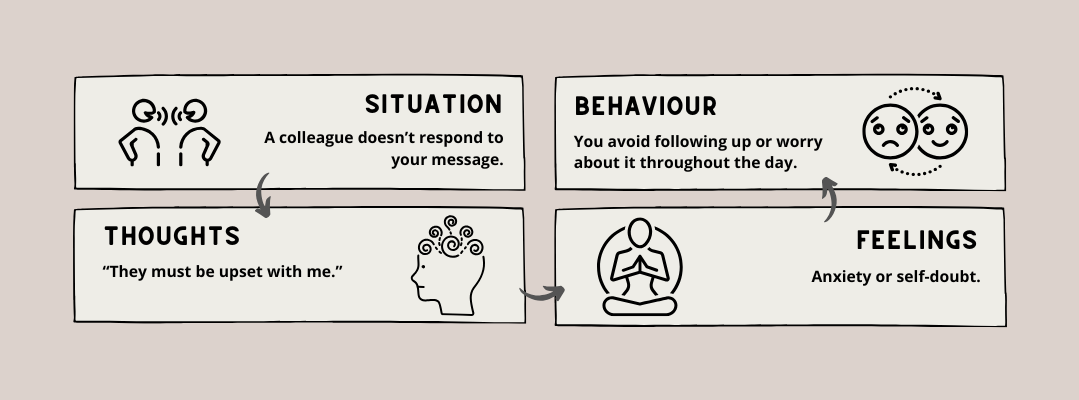
CBT helps you slow this process down and look at what’s happening with greater awareness. The goal isn’t to think positively all the time. It’s to develop a more balanced and flexible relationship with your thoughts.

We may not always be able to choose the thoughts that arise, but we can learn to choose how we respond to them.
What Can CBT Help With?
Anxiety & Overthinking
Working with worry, uncertainty and racing thoughts.
Stress & Burnout
Exploring pressure, expectations and healthier ways to cope.
Self-Esteem & Self-Criticism
Developing a more balanced and compassionate view of yourself.
Perfectionism
Working with perfectionism, self-pressure, and all-or-nothing thinking.
People-Pleasing & Boundaries
Learning to prioritize your needs without being overwhelmed by guilt.
Depression & Low Mood
Working through negative thinking, helplessness, and patterns of withdrawal

What Does CBT Look Like in Therapy?
CBT is practical and collaborative, but your therapy won’t follow a rigid formula.
Together, we may:
Understand your patterns
Explore what’s happening in your life and how your thoughts, emotions, and behaviours are connected.
Notice unhelpful thinking
Identify automatic thoughts and beliefs that may be contributing to anxiety, self-doubt, or overwhelm.
Explore new perspectives
Gently question assumptions and consider more balanced and flexible ways of understanding situations.
Practice new responses
Develop practical strategies and behaviours that you can bring into your everyday life.
Adjust therapy to you
Your goals, experiences, pace, and needs guide the work.
Our Approach to CBT at A Welcoming Home Psychotherapy
Practical, but still deeply human.

Tianna Home, MACP, RP
Founder and Registered Psychotherapist
At A Welcoming Home, we often integrate CBT with other therapeutic approaches to create a more personalized experience. Your therapist may draw from different approaches depending on your goals, experiences, and needs.
Including:
Trauma-informed therapy
This allows us to look beyond simply “How can I change this thought?”. We believe therapy can offer both practical tools for everyday life and deeper understanding of yourself.
Meet Our CBT Therapist Team


Christine Nichols
RP(Qualifying), MACP
Elspeth Hudson
RP, MACP

Tianna Home
Founder, RP, MACP


Rachael Tontodonati
RSW, MSW
Rebecca O’Toole
RP(Qualifying), M.Ed.

Is Cognitive Behavioural Therapy Right for You?
CBT may be a helpful approach if you:
Feel caught in cycles of worry or overthinking
Are often self-critical or hard on yourself
Struggle with perfectionism
Want practical tools you can use outside of therapy
Feel stuck in recurring patterns
Want to better understand the connection between your thoughts, emotions, and behaviours
You don’t need to know whether CBT is the right approach before reaching out. That’s part of what your therapist can help you explore.
Frequently Asked Questions About
Cognitive Behavioural Therapy
-
Cognitive Behavioural Therapy (CBT) can help with anxiety, depression, stress, panic attacks, self-esteem challenges, perfectionism, emotional regulation difficulties, and unhelpful thought patterns. CBT focuses on identifying and changing patterns of thinking and behaviour that may be contributing to emotional distress.
-
CBT works by helping individuals recognize the connection between thoughts, emotions, and behaviours. In therapy, clients learn practical strategies to challenge unhelpful thinking patterns, regulate emotions, and develop healthier coping skills that support long-term emotional wellbeing.
-
No. While CBT helps individuals identify and challenge unhelpful thinking patterns, it also focuses on emotions, behaviours, coping strategies, and nervous system responses. CBT is often integrated with mindfulness, self-compassion, and other therapeutic approaches.
-
Many CBT treatment plans range between 8–20 sessions, although therapy length varies depending on individual goals and needs.
-
Sometimes therapists may suggest exercises between sessions to help practice new skills. These are collaborative and flexible, designed to support real-life change.
-
Yes. CBT is widely considered one of the most effective treatments for anxiety disorders. It helps individuals identify anxious thought patterns and develop practical coping strategies.
-
Yes. CBT teaches strategies to identify and challenge repetitive thinking patterns, helping individuals respond to thoughts in a more balanced and constructive way.
-
Yes. CBT and Acceptance and Commitment Therapy (ACT) are often integrated in therapy. While CBT focuses on identifying and changing unhelpful thoughts, ACT helps individuals change their relationship with thoughts and emotions while taking action aligned with personal values.
-
Getting started is simple. You can reach out to book a consultation or first session, and we’ll take things one step at a time. You don’t have to have everything figured out to begin, we can explore and discover together.
Have other questions?
Get in touch with us.

You don’t have to figure
it all out alone.
Starting therapy can feel vulnerable. You may not know exactly what’s wrong - you may simply be tired of overthinking, being hard on yourself, or feeling stuck. You don’t need to have the right words or know whether CBT is right for you.
A consultation is a chance to ask questions, share what you’re experiencing, and see wheather we might be a good fit. Sometimes, the first step is simply reaching out.
A WELCOMING HOME PSYCHOTHERAPY IN TORONTO & ACROSS ONTARIO
Ready to Take the First Step?
Whether you prefer virtual sessions that fit into your busy schedule or in-person counselling sessions in Toronto, we are here to support you!
Let’s Connect!
Finding the right therapist is personal. A free consultation gives you the opportunity to ask questions, share what you’re looking for, and see if we’re a good fit.
Prefer to book directly? You can also book your first appointment online.
Contact Information
Call Us:(249)206-0429
Email us: info@awelcominghomepsychotherapy.ca

When you’re ready to feel at home within.
A Welcoming Home Psychotherapy
Reconnecting with your inner self.