Have you ever had a moment where your reaction felt bigger than the situation? Maybe someone made a small comment, but it stayed with you all day. Maybe a stressful email sent your mind into a spiral. Maybe you found yourself becoming frustrated, tearful, or overwhelmed over something that normally would not affect you as much. Or maybe you experience the opposite. Instead of feeling everything intensely, you find yourself feeling disconnected, numb, exhausted, or like you are simply “going through the motions.”
Many people I work with in therapy describe these moments with a lot of frustration:
“Why can’t I just handle things better?”
“Why am I reacting this way?”
“Why do I feel like I’m either overwhelmed or completely shut down?”
One of the first things I want clients to know is that these experiences are often not about a lack of strength, maturity, or coping ability. They are often signs that your nervous system is doing exactly what it was designed to do: trying to protect you. This is where understanding your Window of Tolerance can be incredibly helpful.
What is the Window of Tolerance?
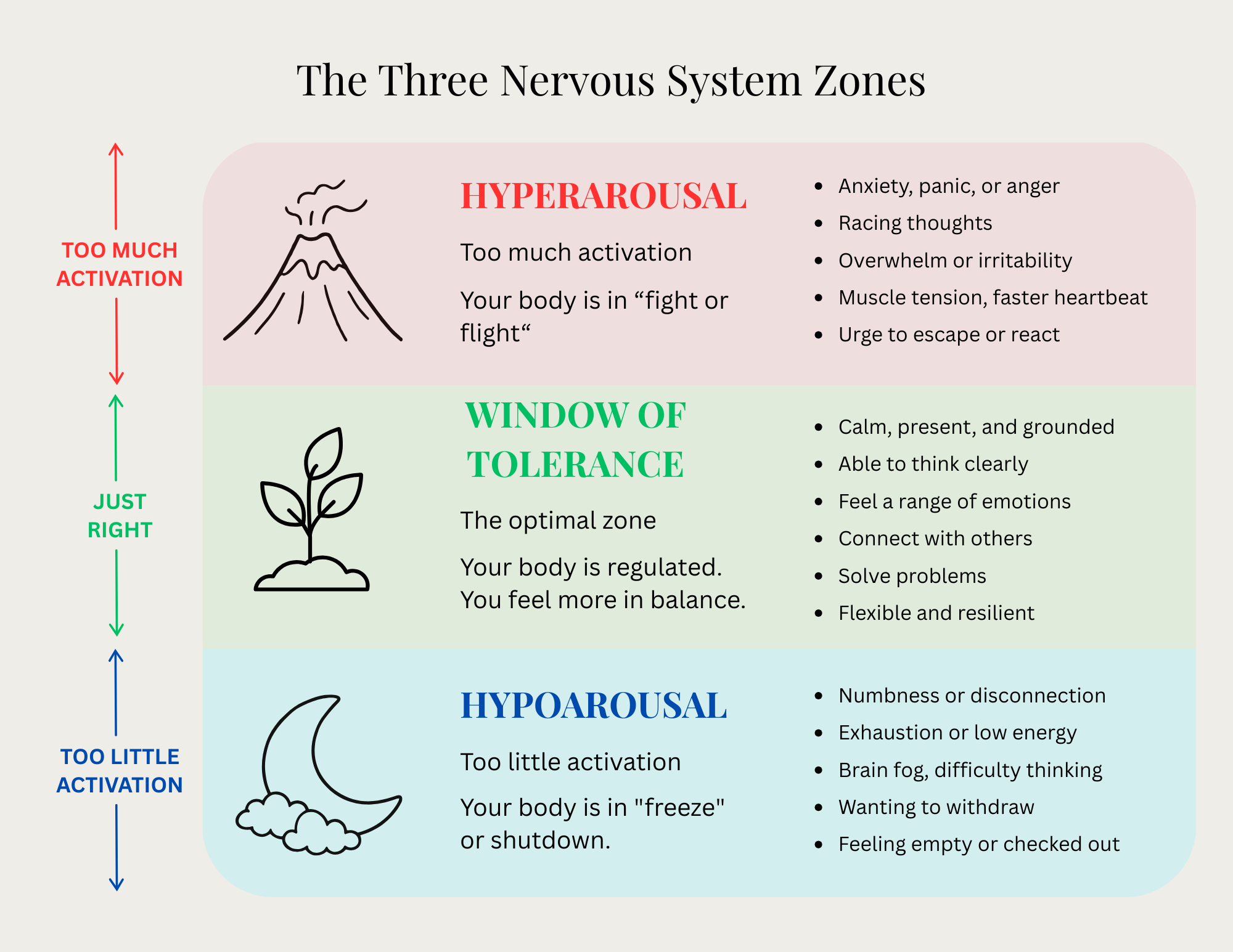
The term Window of Tolerance was introduced by psychiatrist Dr. Dan Siegel to describe the optimal zone of emotional and physiological arousal where we are able to function effectively. Simply put, your Window of Tolerance is the space where you feel regulated enough to experience emotions, think clearly, connect with others, and respond to challenges.
When you are within your window, you might notice that you are able to:
Pause before reacting
Think through situations more clearly
Communicate your needs
Handle stress more effectively
Stay connected to yourself and others
Experience emotions without feeling consumed by them
Being within your Window of Tolerance does not mean that you are happy all the time or that nothing bothers you. Life is stressful. Relationships are complicated. Difficult emotions are part of being human.
Emotional regulation does not mean eliminating emotions. It means having enough internal safety and capacity to experience emotions without feeling completely overwhelmed by them.
When We Move Outside Our Window
The reality is that everyone moves outside their Window of Tolerance sometimes. Stress, lack of sleep, relationship conflict, major life changes, illness, trauma experiences, burnout, and ongoing pressure can all impact our ability to regulate.
I always tell clients to think about their nervous system like a cup. Every stressful experience adds a little bit of water. A difficult conversation. A demanding work week. Feeling disconnected from others. Financial stress. Poor sleep. Unprocessed emotions. When your cup begins to overflow, even a small additional stressor can feel like too much. This is often when people notice themselves moving into one of two states: Hyperarousal or Hypoarousal.
Hyperarousal: When Your Nervous System Goes Into Overdrive
Hyperarousal is when your nervous system becomes highly activated. This is often associated with the body’s fight-or-flight response.
You may notice:
Racing thoughts
Anxiety or panic
Irritability or anger
Feeling emotionally flooded
Difficulty slowing down
Feeling restless or on edge
Increased heart rate
Trouble concentrating
Feeling like everything is urgent
Many people describe this experience as:
“I feel like I can’t turn my brain off”
“I know I’m overreacting, but I can’t stop”
“I feel like I’m always waiting for something bad to happen”
When we are in this state, our brain is prioritizing survival. Our nervous system is scanning for danger and preparing us to respond. This means the parts of our brain responsible for patience, perspective-taking, and problem-solving may not work as efficiently. This is why trying to “think your way out” of intense emotional activation can sometimes feel impossible. Your body may need support before your mind can fully engage.
Hypoarousal: When Your Nervous System Shuts Down
While many people are familiar with anxiety and feeling overwhelmed, fewer people recognize the shutdown response. Hypoarousal happens when your nervous system becomes under-activated. Instead of speeding up, your system slows down.
You may experience:
Feeling numb
Emotional disconnection
Exhaustion
Difficulty thinking clearly
Feeling detached
Wanting to withdraw
Low motivation
Feeling frozen or stuck
Some people describe this as:
“I feel like I’m not really present”
“I know I should do things, but I can’t seem to start”
“I feel nothing, and that scares me”
This response is also protective. When something feels too overwhelming, the nervous system may attempt to reduce the intensity of the experience by creating distance from it. Again, this is not a sign of failure - it is your body attempting to help you cope.
Why Is the Window of Tolerance Important in Therapy?
A big part of therapy involves helping people develop greater emotional awareness and regulation. Before we can change patterns, we first need to understand them. Many people come into therapy believing their too sensitive, too emotional, or my favourite, that they “should” be able to handle this. But often, what is happening is much more complex. Your reactions make sense when we understand the experiences, stressors, and patterns that shaped your nervous system.
Therapy can provide a space to explore:
What triggers you emotionally
How your body responds to stress
Patterns you learned earlier in life
Coping strategies that may no longer be helpful
New ways to create safety and stability within yourself
Research on emotion regulation has consistently highlighted the importance of understanding and developing skills to manage emotional responses, as difficulties with emotion regulation are connected to many areas of mental health and well-being.
How Can You Expand Your Window of Tolerance?
Now you might be wondering “so, how can someone expand their window of tolerance to be feel regulated enough to experience emotions, think clearly, connect with others, and respond to challenges”. Well, I would say that the goal is not to never leave your window - this is unrealistic. But rather, the goal is to build awareness and develop skills that help you return to your window!
Here are some places to start:
-
Often, our nervous system gives us signals before we become completely overwhelmed.
Ask yourself:
“What happens in my body before I reach my limit?”
Maybe you notice:
Tight shoulders
Clenched jaw
Faster breathing
Feeling impatient
Wanting to withdraw
Racing thoughts
Learning these signs allows you to respond earlier.
-
Grounding helps bring your attention back to the present moment.
Some examples include:
Taking slow, intentional breaths
Naming five things you can see
Feeling your feet on the floor
Holding a comforting object
Noticing sensations around you
Grounding is not about forcing yourself to calm down.
It is about reminding your nervous system: “I am here. I am safe in this moment.”
-
One of the biggest misconceptions about coping skills is that we only need them during a crisis. In reality, regulation is a practice. Just like strengthening a muscle, your nervous system benefits from consistent support.
This may include:
Regular movement
Adequate sleep
Nourishing relationships
Time outdoors
Mindfulness practices
Self-compassion
Healthy boundaries
Small, repeated moments of care can create meaningful change.

Understanding Your Own Window Is a Powerful First Step
One of the most important parts of emotional regulation is developing curiosity. Instead of asking: “What is wrong with me?”
Try asking: “What is my nervous system trying to communicate?”
Your emotions are not your enemy. Your reactions are not proof that you are broken. It is all information. When we learn to listen to our emotions and understand our nervous system responses, we create more space for choice, compassion, and change.
If this resonates with you
If you often feel overwhelmed by emotions, stuck in anxious thoughts, disconnected from yourself, or unsure how to respond differently, therapy can help. At A Welcoming Home Psychotherapy, we believe healing begins with understanding yourself with compassion. Therapy provides a supportive space to explore your emotions, patterns, relationships, and experiences while developing practical tools that help you feel more grounded and connected. You do not have to navigate these experiences alone. Sometimes the first step toward feeling more like yourself again is simply learning to understand what your mind and body have been trying to communicate all along.
If you’d like additional support, I invite you to explore or Stress Therapy page, Anxiety Therapy page and Individual Therapy pages to learn more about how therapy can help!
Reach out today to begin understanding your nervous system, building emotional resilience, and learning practical skills to help you navigate life's challenges with greater confidence and compassion.
Free Resource: Understanding Your Window of Tolerance Worksheet
To help you explore your own emotional patterns, I created a free Understanding Your Window of Tolerance Worksheet.
Download: Understanding Your Window of Tolerance
Click here to view our emotional regulation resources
Click here to view all of our resources
Related Reading:
Written by Tianna Home, RP, MACP
Registered Psychotherapist and Clinical Director at A Welcoming Home Psychotherapy